


SpruceID at the SEC Roundtable
SpruceID demonstrated how privacy-preserving digital identity can enhance financial security without compromising civil liberties.
At the 2025 NAPHSIS Identity & Security Conference, SpruceID Founder & CEO Wayne Chang delivered a forward-looking talk on one of the most urgent challenges facing public agencies today: how to strengthen trust in identity systems at a time when AI-driven fraud, rising service demands, and evolving privacy expectations are reshaping the digital landscape. His presentation, Identity, Privacy, and Trust: Building the Next Layer of Digital Verification, outlined why verifiable digital credentials (VDCs) are rapidly becoming essential public infrastructure, and how states can implement them in a secure, privacy-preserving, and interoperable manner.
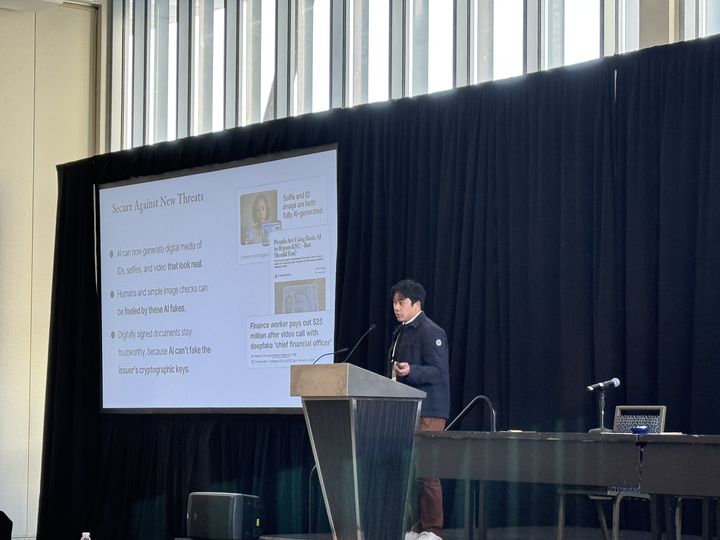
Wayne opened by posing a simple but foundational question: Why digitize anything at all? His answer touched on five pillars that define the next decade of digital public services:
SpruceID’s work with major state programs, such as the California DMV and the State of Utah, illustrates how digital identity can be delivered at scale.
California’s statewide mobile ID program is designed for both offline airport use and secure online verification. Wayne highlighted features such as short-lived credentials, selective disclosure, and full alignment with CCPA and DMV rulemaking, ensuring resident privacy at every step.
Utah’s program enables agencies such as Local Health Departments and the Department of Natural Resources to issue secure, revocable, offline-capable credentials. Like California, Utah embeds strict privacy requirements, complying with the Utah Consumer Privacy Act (UCPA) and prohibiting unnecessary tracking or data reuse.
Across both states, the core lessons are consistent: adopt open standards, prioritize privacy, ensure multi-vendor support, and design for long-term governance.
Wayne offered a clear walkthrough of how verifiable digital credentials function across issuance, storage, and verification. These credentials are:
He also demonstrated how a digitally signed vital record, such as a birth certificate, can be issued by a county, added to a compliant wallet (e.g., DMV, Apple, Google), and instantly verified by relying parties. This flow connects seamlessly with existing systems such as HL7 and NAPHSIS EVVE, offering a bridge from long-standing vital records infrastructure to modern, cryptographically secure formats.
To accelerate adoption, Wayne outlined four actionable steps for states and agencies:
These steps position digital vital records not as experimental add-ons, but as essential public infrastructure.
Lastly, Wayne highlighted the accelerating policy landscape:
Governments across the globe are converging on the same principles: local control, open standards, strong privacy, and vendor diversity.
The session closed with an invitation for collaboration. Building trustworthy digital identity systems requires coordination across agencies, states, vendors, and the broader public-sector community. However, the payoff is clear: more secure systems, greater privacy for residents, reduced risk of fraud, and faster, more efficient public services.
SpruceID’s work demonstrates that this future is already underway, and that digital vital records can serve as a foundational trust layer for the next generation of digital government. Learn how SpruceID can help your state advance secure, privacy-preserving digital vital records. Contact our team to get started.
Building digital services that scale take the right foundation.
About SpruceID: SpruceID is building a future where users control their identity and data across all digital interactions. We build privacy-preserving digital identity infrastructure that empowers people and organizations to control their data. Governments, financial institutions, and enterprises use SpruceID’s technology to issue, verify, and manage digital credentials based on open standards.